What Is Baby Powder Composed of What Countries Does Baby Powder Come From?
| Talc | |
|---|---|
 | |
| General | |
| Category | Silicate mineral |
| Formula (repeating unit) | Mg3Si4O10(OH)2 |
| IMA symbol | Tlc[1] |
| Strunz classification | 9.EC.05 |
| Crystal system | Monoclinic or triclinic[2] |
| Crystal course | Either prismatic (2m) or pinacoidal (one)[three] |
| Space grouping | C2/c or C1 |
| Unit cell | a = five.291 Å, b = ix.173 Å c = 5.290 Å; α = 98.68° β = 119.90°, γ = 90.09°; Z = 2 or a = five.287 Å, b = ix.158 Å c = 18.95 [Å], β = 99.3°; Z = 4[3] |
| Identification | |
| Color | Light to dark dark-green, brown, white, gray, colorless |
| Crystal habit | Foliated to fibrous masses, rare as platey to pyramidal crystals |
| Cleavage | Perfect on {001} basal cleavage |
| Fracture | Flat surfaces (not cleavage), fracture in an uneven pattern |
| Tenacity | Sectile |
| Mohs scale hardness | 1 (defining mineral) |
| Luster | Waxlike or pearly |
| Streak | White jot to pearl black |
| Diaphaneity | Translucent |
| Specific gravity | two.58 to 2.83 |
| Optical backdrop | Biaxial (-) |
| Refractive index | nα = 1.538 – 1.550 nβ = 1.589 – one.594 nγ = one.589 – 1.600 |
| Birefringence | δ = 0.051 |
| Pleochroism | Weak in dark varieties |
| Ultraviolet fluorescence | Short UV=orange yellow, long UV=yellow |
| References | [3] [4] [v] |
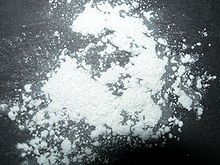
Talc, or talcum, is a clay mineral, composed of hydrated magnesium silicate with the chemical formula Mg3Si4Ox(OH)2. Talc in powdered course, often combined with corn starch, is used as baby pulverization. This mineral is used as a thickening agent and lubricant. It is an ingredient in ceramics, paint, and roofing material. It is a main ingredient in many cosmetics.[6] It occurs equally foliated to fibrous masses, and in an exceptionally rare crystal form. It has a perfect basal cleavage and an uneven apartment fracture, and it is foliated with a two-dimensional platy course.
The Mohs scale of mineral hardness, based on scratch hardness comparing, defines value ane as the hardness of talc, the softest mineral. When scraped on a streak plate, talc produces a white streak; though this indicator is of piffling importance, because near silicate minerals produce a white streak. Talc is translucent to opaque, with colors ranging from whitish gray to greenish with a vitreous and pearly luster. Talc is not soluble in water, and is slightly soluble in dilute mineral acids.[7]
Soapstone is a metamorphic rock composed predominantly of talc.
Etymology [edit]
The word "talc" derives from Medieval Latin talcum, which in turn originates from Arabic: طلق ṭalq which, derives from Persian: تالک tālk. In ancient times, the word was used for various related minerals, including talc, mica, and selenite.[eight]
Formation [edit]

Talc dominantly forms from the metamorphism of magnesian minerals such every bit serpentine, pyroxene, amphibole, and olivine, in the presence of carbon dioxide and water. This is known as "talc carbonation" or "steatization" and produces a suite of rocks known as talc carbonates.
Talc is primarily formed past hydration and carbonation past this reaction:
- serpentine two Mg3SitwoOfive(OH)four + carbon dioxide iii CO2 → talc Mg3Si4O10(OH)ii + magnesite three MgCO3 + water 3 H2O
Talc can also be formed via a reaction betwixt dolomite and silica, which is typical of skarnification of dolomites past silica-flooding in contact metamorphic aureoles:
- dolomite 3 CaMg(CO3)2 + silica four SiO2 + water H2O → talc Mg3Si4O10(OH)2 + calcite 3 CaCOthree + carbon dioxide 3 CO2
Talc tin also be formed from magnesian chlorite and quartz in blueschist and eclogite metamorphism by the following metamorphic reaction:
- chlorite + quartz → kyanite + talc + water
Talc is also found equally a diagenetic mineral in sedimentary rocks where it tin form from the transformation of metastable hydrated magnesium-clay precursors such as kerolite, sepiolite, or stevensite that can precipitate from marine and lake h2o in certain weather.[9]
In this reaction, the ratio of talc and kyanite depends on aluminium content, with more aluminous rocks favoring production of kyanite. This is typically associated with high-pressure, depression-temperature minerals such as phengite, garnet, and glaucophane inside the lower blueschist facies. Such rocks are typically white, friable, and gristly, and are known equally whiteschist.
Talc is a trioctahedral layered mineral; its structure is similar to pyrophyllite, but with magnesium in the octahedral sites of the composite layers.[2]
Occurrence [edit]

Talc is a common metamorphic mineral in metamorphic belts that incorporate ultramafic rocks, such as soapstone (a high-talc stone), and within whiteschist and blueschist metamorphic terranes. Prime examples of whiteschists include the Franciscan Metamorphic Belt of the western U.s., the western European Alps especially in Italy, certain areas of the Musgrave Block, and some collisional orogens such every bit the Himalayas, which stretch along Islamic republic of pakistan, India, Nepal, and Kingdom of bhutan.
Talc carbonate ultramafics are typical of many areas of the Archaean cratons, notably the komatiite belts of the Yilgarn Craton in Western Australia. Talc-carbonate ultramafics are besides known from the Lachlan Fold Chugalug, eastern Australia, from Brazil, the Guiana Shield, and from the ophiolite belts of Turkey, Oman, and the Middle Eastward.
Communist china is the key globe talc and steatite producing country with an output of well-nigh 2.2M tonnes(2016), which accounts for 30% of total global output. The other major producers are Brazil (12%), India (xi%), the U.Southward. (9%), French republic (6%), Finland (iv%), Italian republic, Russian federation, Canada, and Austria (2%, each).[10]
Notable economic talc occurrences include the Mount Seabrook talc mine, Western Australia, formed upon a polydeformed, layered ultramafic intrusion. The France-based Luzenac Group is the world's largest supplier of mined talc. Its largest talc mine at Trimouns near Luzenac in southern France produces 400,000 tonnes of talc per year.
Disharmonize mineral [edit]
Extraction in disputed areas of Nangarhar province, Afghanistan, has led the international monitoring group Global Witness to declare talc a conflict resource, as the profits are used to fund armed confrontation between the Taliban and Islamic Country.[11]
Uses [edit]

The structure of talc is equanimous of Si2O5 sheets with magnesium sandwiched between sheets in octahedral sites.
Talc is used in many industries, including newspaper making, plastic, paint and coatings (e.g. for metal casting molds), safety, nutrient, electric cablevision, pharmaceuticals, cosmetics, and ceramics. A coarse grayish-dark-green loftier-talc rock is soapstone or steatite, used for stoves, sinks, electrical switchboards, etc. It is often used for surfaces of laboratory table tops and electric switchboards because of its resistance to rut, electricity and acids.
In finely ground form, talc finds use as a cosmetic (talcum powder), as a lubricant, and every bit a filler in paper industry. It is used to glaze the insides of inner tubes and safety gloves during manufacture to go on the surfaces from sticking. Talcum powder, with heavy refinement, has been used in babe powder, an astringent powder used to forestall diaper rash (nappy rash). The American Academy of Pediatrics recommends that parents avoid using baby powder because it poses a take chances of respiratory problems, including breathing trouble and serious lung damage if inhaled. The small size of the particles makes it hard to proceed them out of the air while applying the powder. Zinc oxide-based ointments are a much safer culling.[12]
Soapstone (massive talc) is often used as a marking for welding or metalworking.[thirteen] [14]
Talc is also used as food additive or in pharmaceutical products as a glidant. In medicine, talc is used as a pleurodesis agent to foreclose recurrent pleural effusion or pneumothorax. In the European Union, the additive number is E553b.
Talc may be used in the processing of white rice as a buffing agent in the polishing stage.
Due to its low shear strength, talc is one of the oldest known solid lubricants. Also a express employ of talc every bit friction-reducing additive in lubricating oils is made.[15]
Talc is widely used in the ceramics manufacture in both bodies and glazes. In low-burn down art-ware bodies, it imparts whiteness and increases thermal expansion to resist crazing. In stonewares, small percentages of talc are used to flux the body and therefore improve strength and vitrification. It is a source of MgO flux in high-temperature glazes (to command melting temperature). It is also employed every bit a matting agent in earthenware glazes and can be used to produce magnesia mattes at high temperatures.
ISO standard for quality (ISO 3262)
| Blazon | Talc content min. wt% | Loss on ignition at k °C, wt % | Solubility in HCl, max. wt % |
|---|---|---|---|
| A | 95 | 4 – 6.five | v |
| B | xc | 4–ix | 10 |
| C | 70 | 4–18 | thirty |
| D | 50 | 4–27 | 30 |
Patents are awaiting on the apply of magnesium silicate as a cement substitute. Its production requirements are less energy-intensive than ordinary Portland cement (at a heating requirement of around 650 °C for talc compared to 1500 °C for limestone to produce Portland cement), while information technology absorbs far more than carbon dioxide equally information technology hardens. This results in a negative carbon footprint overall, as the cement substitute removes 0.6 tonnes of COtwo per tonne used. This contrasts with a positive carbon footprint of 0.4 tonne per tonne of conventional cement.[xvi]
Talc is used in the product of the materials that are widely used in the building interiors such as base content paints in wall coatings. Other areas that use talc to a neat extent are organic agriculture, nutrient industry, cosmetics, and hygiene products such every bit baby pulverization and detergent powder.
Talc is sometimes used every bit an adulterant to illegal heroin, to expand volume and weight and thereby increase its street value. With intravenous apply, it may lead to pulmonary talcosis, a granulomatous inflammation in the lungs.
Sterile talc powder [edit]
Sterile talc powder (NDC 63256-200-05) is a sclerosing amanuensis used in the process of pleurodesis. This tin be helpful as a cancer treatment to foreclose pleural effusions (an abnormal collection of fluid in the infinite between the lungs and the thoracic wall). It is inserted into the space via a breast tube, causing information technology to shut up, so fluid cannot collect there. The product can exist sterilized by dry out heat, ethylene oxide, or gamma irradiation.[17]
Condom [edit]
Suspicions have been raised that talc use contributes to certain types of affliction, mainly cancers of the ovaries and lungs. According to the IARC, talc containing asbestos is classified as a grouping 1 amanuensis (carcinogenic to humans), talc use in the perineum is classified as group 2B (possibly carcinogenic to humans), and talc non containing asbestos is classified as group 3 (unclassifiable as to carcinogenicity in humans).[xviii] Reviews by Cancer Enquiry U.k. and the American Cancer Society conclude that some studies have found a link, but other studies have not.[19] [twenty]
The studies discuss pulmonary issues,[21] lung cancer,[22] [23] and ovarian cancer.[24] One of these, published in 1993, was a U.s.a. National Toxicology Plan written report, which found that cosmetic grade talc containing no asbestos-like fibres was correlated with tumor germination in rats forced to inhale talc for 6 hours a day, five days a week over at to the lowest degree 113 weeks.[22] A 1971 paper plant particles of talc embedded in 75% of the ovarian tumors studied.[25] Research published in 1995 and 2000 concluded that it was plausible that talc could cause ovarian cancer, but no conclusive evidence was shown.[26] [27] The Cosmetic Ingredient Review Expert Console ended in 2015 that talc, in the concentrations currently used in cosmetics, is safe.[28] In 2018, Health Canada issued a alarm, advising against inhaling talcum powder or using it in the female perineal area.[29]
Industrial grade [edit]
In the United states, the Occupational Safety and Health Assistants and National Institute for Occupational Safety and Wellness have gear up occupational exposure limits to respirable talc dusts at 2 mg/m3 over an eight-hr workday. At levels of 1000 mg/one thousandiii, inhalation of talc is considered immediately unsafe to life and health.[30]
Food grade [edit]
The United states Food and Drug Administration considers talc (magnesium silicate) mostly recognized every bit safe (GRAS) to use as an anticaking agent in table salt in concentrations smaller than ii%.[31]
Association with asbestos [edit]
One item consequence with commercial use of talc is its frequent co-location in underground deposits with asbestos ore. Asbestos is a general term for unlike types of gristly silicate minerals, desirable in construction for their heat resistant properties.[32] There are six varieties of asbestos; the nigh mutual variety in manufacturing, white asbestos, is in the serpentine family.[33] Serpentine minerals are sheet silicates; although not in the serpentine family, talc is also a sheet silicate, with ii sheets connected by magnesium cations. The frequent co-location of talc deposits with asbestos may result in contamination of mined talc with white asbestos, which poses serious health risks when dispersed into the air and inhaled. Stringent quality control since 1976, including separating corrective- and food-grade talc from "industrial"-grade talc, has largely eliminated this result, merely it remains a potential hazard requiring mitigation in the mining and processing of talc.[34] A 2010 US FDA survey failed to find asbestos in a variety of talc-containing products.[35] A 2018 Reuters investigation asserted that pharmaceuticals company Johnson & Johnson knew for decades that there was asbestos in its baby pulverisation,[36] and in 2020 the company stopped selling its baby powder in the US and Canada.[37]
Litigation [edit]
In 2006 the International Agency for Research on Cancer classified talcum pulverization equally a possible human carcinogen if used in the female genital surface area. Despite this, no federal agency in the United states acted to remove talcum powder from the market or add warnings.[38]
In February 2016, every bit the effect of a lawsuit against Johnson & Johnson (J&J), a St. Louis jury awarded $72 million to the family of an Alabama adult female who died from ovarian cancer. The family claimed that the use of talcum powder was responsible for her cancer.
In May 2016, a Southward Dakota woman was awarded $55 one thousand thousand every bit the result of another lawsuit confronting J&J.[39] The adult female had used Johnson & Johnson's Baby Powder for more 35 years before being diagnosed with ovarian cancer in 2011.[40]
In October 2016, a St. Louis jury awarded $lxx.ane 1000000 to a Californian woman with ovarian cancer who had used Johnson'southward Baby Powder for 45 years.[41]
In Baronial 2017, a Los Angeles jury awarded $417 million to a Californian woman, Eva Echeverria, who developed ovarian cancer equally a "proximate outcome of the unreasonably dangerous and defective nature of talcum powder", her lawsuit against Johnson & Johnson stated.[42] On xx Oct 2017, Los Angeles Superior Court judge Maren Nelson dismissed the verdict. The judge stated that Echeverria proved there is "an ongoing fence in the scientific and medical community virtually whether talc more than probably than non causes ovarian cancer and thus (gives) rise to a duty to warn", just not plenty to sustain the jury's imposition of liability confronting Johnson & Johnson stated, and concluded that Echeverria did not adequately establish that talc causes ovarian cancer.[43] [44]
In July 2018, a court in St. Louis awarded a $4.7bn claim ($4.14bn in punitive amercement and $550m in compensatory damages) against J&J to 22 claimant women, concluding that the company had suppressed evidence of asbestos in its products for more than 4 decades.[45]
At to the lowest degree 1,200 to 2,000 other talcum powder-related lawsuits are awaiting.[41] [46]
See also [edit]
- Pyrophyllite – Aluminium silicate hydroxide phyllosilicate mineral
- Sillimanite – Nesosilicate mineral
- Serpentinite – Stone formed by hydration and metamorphic transformation of olivine
References [edit]
- ^ Warr, L.N. (2021). "IMA–CNMNC approved mineral symbols". Mineralogical Magazine. 85 (3): 291–320. Bibcode:2021MinM...85..291W. doi:10.1180/mgm.2021.43. S2CID 235729616.
- ^ a b An Introduction to the Stone-Forming Minerals, 2 ed., past W.A. Deer, R.A. Howie, and J. Zussman, 1992, Prentice Hall, ISBN 0-582-30094-0.
- ^ a b c Anthony, John W.; Bideaux, Richard A.; Bladh, Kenneth W.; Nichols, Monte C., eds. (1995). "Talc" (PDF). Handbook of Mineralogy. Vol. II (Silica, Silicates). Chantilly, VA, Usa: Mineralogical Guild of America. ISBN0962209716.
- ^ Talc. Mindat.org
- ^ Talc. Webmineral
- ^ "Talc". Minerals Pedagogy Coalition.
- ^ Profiles of Drug Substances, Excipients and Related Methodology, Volume 36 ISBN 978-0-123-87667-six p. 283
- ^ Harper, Douglas. "talc". Online Etymology Dictionary.
- ^ Strauss, Justin V.; MacDonald, Francis A.; Halverson, Galen P.; Tosca, Nicholas J.; Schrag, Daniel P.; Knoll, Andrew H. (2015). "Stratigraphic evolution of the Neoproterozoic Callison Lake Formation: Linking the intermission-up of Rodinia to the Islay carbon isotope excursion". American Periodical of Science. American Journal of Scientific discipline (AJS). 315 (10): 881–944. Bibcode:2015AmJS..315..881S. doi:x.2475/x.2015.01. ISSN 0002-9599. S2CID 130671089.
- ^ Sergeeva, Anna (xviii July 2018). "Mainland china, Brazil, the U.S. and Bharat Remain the Major Consumers on the Global Talc Market". IndexBox.
- ^ "Talc: the everyday mineral funding Afghan insurgents". Global Witness. Archived from the original on 24 May 2018. Retrieved 24 May 2018.
- ^ "Is it safe to utilise baby powder on my baby?". Babycenter.com (2017-05-01). Retrieved on 2017-05-06.
- ^ "Why Do Welders Use Soapstone?". Welders Manual . Retrieved 7 March 2022.
- ^ Immature, Pierre. "What Is Soapstone Used for in Welding?". Welding Headquarters . Retrieved vii March 2022.
- ^ Rudenko, Pavlo; Bandyopadhyay, Amit (2013). "Talc every bit friction reducing additive to lubricating oil". Applied Surface Scientific discipline. 276: 383–389. Bibcode:2013ApSS..276..383R. doi:10.1016/j.apsusc.2013.03.102.
- ^ Jha, Alok (31 December 2008) Revealed: The cement that eats carbon dioxide, The Guardian
- ^ American Thoracic Society (November 2000). "Direction of Cancerous Pleural Effusions". Am J Respir Crit Care Med. 162 (5): 1987–2001. doi:10.1164/ajrccm.162.5.ats8-00. PMID 11069845.
- ^ List of Classifications, International Agency for Inquiry on Cancer
- ^ Talcum powder and cancer, Cancerresearch.uk
- ^ Talcum Pulverisation and Cancer, American Cancer Social club
- ^ Hollinger, MA (1990). "Pulmonary toxicity of inhaled and intravenous talc". Toxicology Letters. 52 (2): 121–7, give-and-take 117–9. doi:10.1016/0378-4274(90)90145-C. PMID 2198684.
- ^ a b National Toxicology, Plan (1993). "NTP Toxicology and Carcinogenesis Studies of Talc (Not-Asbestiform) in Rats and Mice (Inhalation Studies)". National Toxicology Program Technical Written report Series. 421: ane–287. PMID 12616290.
- ^ NIOSH Worker Notification Program (15 June 2020). "Health effects of mining and milling talc".
- ^ Harlow, Cramer, Bell; et al. (1992). "Perineal exposure to talc and ovarian cancer risk". Obstetrics and Gynecology. 80 (1): 19–26. PMID 1603491.
{{cite journal}}: CS1 maint: multiple names: authors listing (link) - ^ Henderson WJ, Joslin CA, Turnbull AC, Griffiths K (1971). "Talc and carcinoma of the ovary and cervix". J Obstet Gynaecol Br Commonw. 78 (3): 266–272. doi:x.1111/j.1471-0528.1971.tb00267.10. PMID 5558843. S2CID 32300387.
- ^ Harlow, BL; Hartge, PA (April 1995). "A review of perineal talc exposure and gamble of ovarian cancer". Regulatory Toxicology and Pharmacology. 21 (ii): 254–sixty. doi:x.1006/rtph.1995.1039. PMID 7644715.
- ^ Gertig, D. M.; Hunter, D. J.; Cramer, D. W.; Colditz, G. A.; Speizer, F. Due east.; Willett, Due west. C.; Hankinson, S. E. (2 February 2000). "Prospective Study of Talc Apply and Ovarian Cancer" (PDF). JNCI Periodical of the National Cancer Found. 92 (3): 249–252. doi:10.1093/jnci/92.3.249. PMID 10655442.
- ^ Gruber, James (Nov–December 2019). "Practice Cosmetic Consumers Really Know What Ingredients They Are Using? An Research into the Search for the 'Truth'". Skeptical Inquirer. 43 (vi): 54.
- ^ "Talc - Potential Risk of Lung Effects and Ovarian Cancer". 19 November 2018.
- ^ "NIOSH Pocket Guide to Chemical Hazards". Centers for Disease Control and Prevention. 2011.
- ^ "Code of Federal Regulations". U.S. Food and Drug Administration. 2009.
- ^ "Asbestos". Minerals Educational activity Coalition.
- ^ Plummer, Charles C.; Carlson, Diane H.; Hammersley, Lisa (22 January 2018). Concrete Geology (Sixteenth ed.). ISBN9781260091656.
- ^ "Is talcum powder asbestos?". The Direct Dope. xvi February 1990. Retrieved 9 March 2019.
- ^ "Talc Ingredients". U.Due south. Food and Drug Administration. 2010.
- ^ "J&J knew for decades that asbestos lurked in its Baby Pulverization". Reuters . Retrieved xv December 2018.
- ^ "Johnson & Johnson stops selling baby powder in U.s.a.". BBC News. xx May 2020. Retrieved xx May 2020.
- ^ Rabin, Roni Caryn (22 August 2017). "$417 Million Awarded in Suit Tying Johnson's Baby Powder to Cancer". The New York Times . Retrieved 13 July 2018.
- ^ McLean, Rob (3 May 2016). "Johnson & Johnson just lost another talcum powder cancer lawsuit". CNNMoney . Retrieved eighteen August 2016.
- ^ "Professor Hanington'due south Speaking of Science: Does talc crusade cancer?". Elko Daily Complimentary Press . Retrieved 9 March 2021.
- ^ a b Does baby pulverisation cause cancer? Another jury thinks so, awarding $lxx million to a California woman. LA Times (2016-10-28). Retrieved on 2017-05-06.
- ^ Jury awards $417M in lawsuit linking talcum powder to cancer. The Chronicle Herald (21 August 2017)
- ^ Bellon, Tina (21 Oct 2017). "California judge tosses $417 one thousand thousand talc cancer verdict against..." Reuters . Retrieved 13 July 2018.
- ^ Frankel, Alison (24 October 2017). "Dismissal of $417 million verdict v. J&J is disaster for talc..." Reuters . Retrieved 13 July 2018.
- ^ Butler, Sarah (13 July 2018). "Johnson & Johnson ordered to pay $iv.7bn in talc powder merits". The Guardian . Retrieved thirteen July 2018.
- ^ Woman wins $55M verdict against Johnson & Johnson in cancer suit. NY Daily News (iii May 2016)
 | Wikimedia Commons has media related to Talc. |
 | Look up talc in Wiktionary, the free dictionary. |
Source: https://en.wikipedia.org/wiki/Talc
0 Response to "What Is Baby Powder Composed of What Countries Does Baby Powder Come From?"
Post a Comment