what is the incarceration rate in the united states compared to other countires

A map of incarceration rates by country[1]

Full United States incarceration by year
The United States has the highest prison and jail population (2,121,600 in developed facilities in 2016), and the highest incarceration charge per unit in the world (655 per 100,000 population in 2016).[1] According to the World Prison house Population List (11th edition) there were effectually x.35 million people in penal institutions worldwide in 2015.[two] The U.s. had 2,173,800 prisoners in adult facilities in 2015.[three] That means the US held 21.0% of the world'south prisoners in 2015, even though the The states represented just effectually 4.four percentage of the world's population in 2015.[4] [5]
Comparing English language-speaking developed countries;[1] the overall incarceration rate in the United states is 639 per 100,000 population of all ages (every bit of 2018),[vi] the incarceration rate of Canada is 104 per 100,000 (every bit of 2018),[seven] England and Wales is 130 per 100,000 (every bit of 2021),[viii] and Australia is 160 per 100,000 (every bit of 2020).[9] Comparing other developed countries, the rate of Spain is 122 per 100,000 (every bit of 2020),[10] France is 90 per 100,000 (equally of 2020),[eleven] Frg is 69 per 100,000 (as of 2020),[12] Norway is 49 per 100,000 (as of 2020),[13] Netherlands is 63 per 100,000 (as of 2018),[14] and Japan is 38 per 100,000 (as of 2019).[15]
Comparing other countries with like percentages of immigrants, Deutschland has a rate of 78 per 100,000 (every bit of 2017),[12] Italy is 96 per 100,000 (as of 2018),[16] and Kingdom of saudi arabia is 197 per 100,000 (every bit of 2017).[17] Comparison other countries with a zero tolerance policy for illegal drugs, the rate of Russia is 411 per 100,000 (as of 2018),[xviii] Kazakhstan is 194 per 100,000 (as of 2018),[19] Singapore is 201 per 100,000 (as of 2017),[20] and Sweden is 57 per 100,000 (equally of 2016).[21]
The incarceration rate of the China varies depending on sources and measures. According to the Earth Prison house Brief, the rate for only sentenced prisoners is 118 per 100,000 (as of 2015). The rate for prisoners including estimations for the number of pre-trial detainees and those in administrative detention is 164 per 100,000 (as of 2015).[22] In a 2010 interview Harry Wu, a U.Due south.-based human rights activist and ex-Chinese labor camp prisoner, estimates that "in the last 60 years, more than xl–50 million people" were in Chinese labor camps,[23] only that menstruum includes the mass incarcerations of the 1950s or the Cultural Revolution (1966-1976) and is non representative of People's republic of china in 2010.
U.S. incarceration rate peaked in 2008 [edit]

U.S. incarceration rate peaked in 2008. Prisoners per 100,000 population.[24] [25]
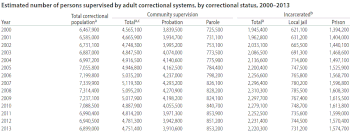
Full US incarceration peaked in 2008. Total correctional population peaked in 2007.[25]
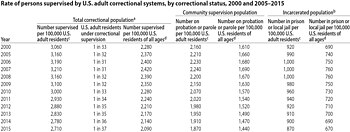
U.s. incarceration and correctional population rates over time. The incarceration rate peaked in 2008.[3]
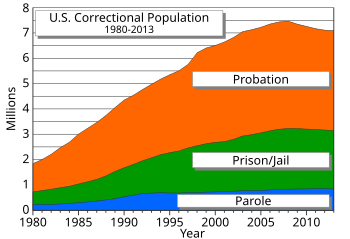
Total Usa incarceration (prisons and jails) peaked in 2008. On January one, 2008 more than i in 100 adults in the United states were in prison or jail.[26] [27] Total correctional population (prison, jail, probation, parole) peaked in 2007.[25] If all prisoners are counted (including juvenile, territorial, Ice, Indian state, and war machine), and then in 2008 the USA had around 24.7% of the earth's ix.8 meg prisoners.[28] [29] [24]
A 2008 article in The New York Times [thirty] said that "it is the length of sentences that truly distinguishes American prison house policy. Indeed, the mere number of sentences imposed hither would not place the United States at the top of the incarceration lists. If lists were compiled based on annual admissions to prison per capita, several European countries would outpace the U.s.a.. But American prison house stays are much longer, so the full incarceration charge per unit is college."
More comparisons [edit]
In the Usa, women brand upwards more than ane 10th of the whole prison house population.[31] In near countries, the proportion of female inmates to the larger population is closer to 1 in xx. Australia is the exception where the rate of female imprisonment increased from 9.two percent in 1991 to 15.3 percent in 1999.[32]
In addition, the U.s. has significant racial disparities in rates of incarceration.[33] According to Michelle Alexander in a 2010 volume, the U.s.a. "imprisons a larger percentage of its black population than Due south Africa did at the height of apartheid".[34] The black imprisonment rate of Southward Africa could not take come close to today'due south American charge per unit but due to limited room. Notably, at that place'due south something of an international theme in countries comparison themselves to apartheid Southward Africa. There were instances where Australian journalists were drawing the same contrast relative to rates of imprisonment in their country.[35] In the Huffington Post piece "Mass Incarceration'south Failure", attorney Antonio Moore states "The incarceration charge per unit for young blackness men ages twenty to 39, is about 10,000 per 100,000. To give context, during the racial discrimination of apartheid in South Africa, the prison rate for black male S Africans, rose to 851 per 100,000."[36]
A major contributor to the high incarceration rates is the length of the prison sentences in the United States. One of the criticisms of the United States system is that it has much longer sentences than any other function of the world. The typical mandatory judgement for a first-time drug crime in federal court is 5 or ten years, compared to other developed countries around the world where a first fourth dimension crime would warrant at most vi months in jail.[34] Mandatory sentencing prohibits judges from using their discretion and forces them to place longer sentences on nonviolent offenses than they commonly would do.
Even though there are other countries that have a college rate of committing inmates to prison annually, the fact that the Usa keeps their prisoners longer causes the full incarceration rate to become college. To requite an case, the average burglary sentence in the The states is 16 months, compared to five months in Canada and seven months in England.[30]
The US incarceration rate peaked in 2008 when about 1,000 in 100,000 U.South. adults were behind bars. That's 760 inmates per 100,000 U.S. residents of all ages.[27] [25] This incarceration rate was like to the average incarceration levels in the Soviet Union during the beingness of the infamous Gulag organization, when the Soviet Union's population reached 168 one thousand thousand, and 1.two to 1.five million people were in the Gulag prison camps and colonies (i.e. about 714 to 892 imprisoned per 100,000 USSR residents, according to numbers from Anne Applebaum and Steven Rosefielde).[37] [38] Some of the latter Soviet Wedlock'south yearly incarceration rates from 1934 to 1953, however, likely were the earth's historically highest for a modern age state.[39] In The New Yorker article The Caging of America (2012), Adam Gopnik writes: "Over all, at that place are at present more than people nether 'correctional supervision' in America—more than six one thousand thousand—than were in the Gulag nether Stalin at its top."[40]
Comparing to OECD countries [edit]
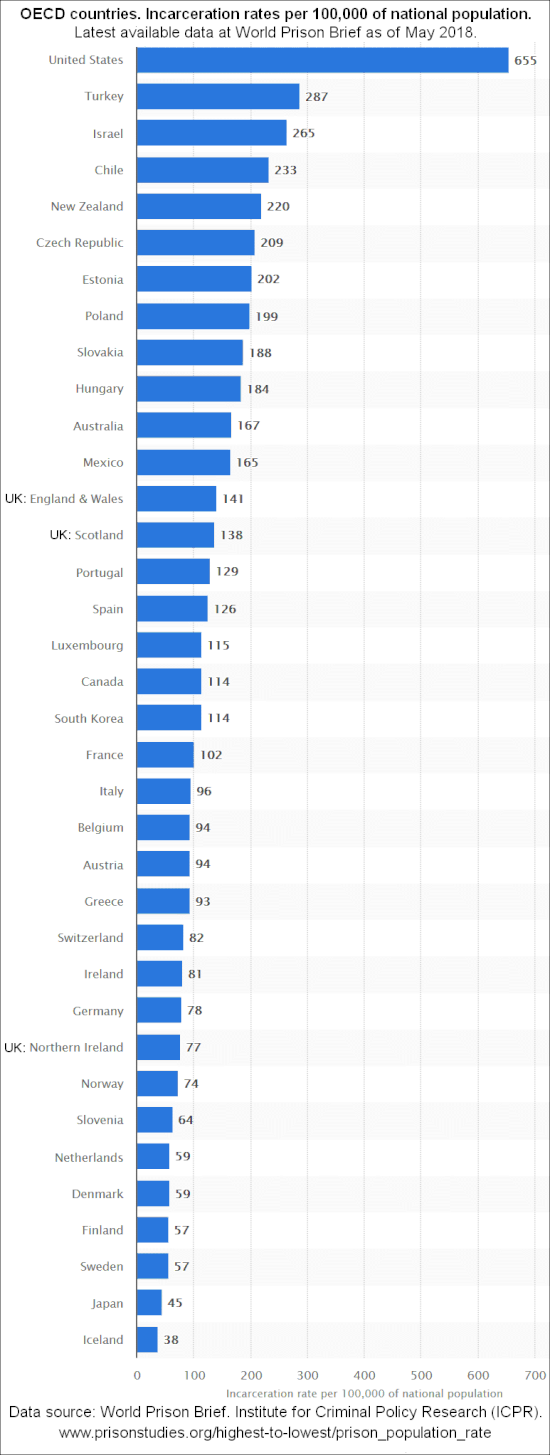
OECD incarceration rates by state. Data is from Globe Prison house Brief.[1]
All only ii US states (the exceptions are Vermont and Massachusetts) have a higher incarceration rate than Turkey, the nation with the second highest incarceration rate amidst OECD countries. Meet: List of U.S. states by incarceration and correctional supervision rate.
See too [edit]
- Listing of U.S. states by incarceration charge per unit
- Incarceration in the United States
- Youth incarceration in the United States
- War on Drugs
References [edit]
- ^ a b c d Highest to Everyman. Earth Prison Brief (WPB). Use dropdown carte du jour to choose lists of countries past region, or the whole world. Use carte du jour to select highest-to-lowest lists of prison population totals, prison house population rates, percentage of pre-trial detainees / remand prisoners, percentage of female prisoners, per centum of foreign prisoners, and occupancy rate. Column headings in WPB tables can be clicked to reorder columns lowest to highest, or alphabetically. For detailed information for each country click on any country name in lists. Run into also the WPB main data folio and click on the map links and/or the sidebar links to get to the region and state desired.
- ^ Walmsley, Roy (2 February 2016). Earth Prison Population List (11th edition) (PDF). From the Research & Publications folio of the World Prison house Brief website. From page 1 of the PDF: "The data is the latest available at the end of October 2015." And from page 2: "This study shows that more than 10.35 million people are held in penal institutions throughout the world, either as pre-trial detainees/remand prisoners or having been convicted and sentenced."
- ^ a b Correctional Populations in the United States, 2015. By Danielle Kaeble and Lauren Glaze, BJS Statisticians. Dec. 2016. Bureau of Justice Statistics. See PDF. Page two says: "At yearend 2015, an estimated 2,173,800 persons were either under the jurisdiction of land or federal prisons or in the custody of local jails in the United States". See too tabular array 4 on page 4: "Charge per unit of persons supervised by U.S. developed correctional systems, by correctional condition, 2000 and 2005–2015".
- ^ Population Clock. U.S. Demography Bureau. 321,032,786 people in the US on June thirty, 2015.
- ^ The Earth Population Prospects: 2015 Revision. 29 July 2015 article. From United Nations Department of Economic and Social Affairs. 7.three billion people in 2015.
- ^ Usa of America. World Prison Cursory.
- ^ Canada. Globe Prison Cursory.
- ^ Uk: England & Wales. World Prison Cursory.
- ^ Australia. World Prison Cursory.
- ^ Spain. Earth Prison Cursory.
- ^ French republic. World Prison Cursory.
- ^ a b Germany. World Prison Cursory.
- ^ Kingdom of norway. Globe Prison Brief.
- ^ Netherlands. Earth Prison Cursory.
- ^ Japan. World Prison Brief.
- ^ Italy. World Prison house Brief.
- ^ Saudi Arabia. World Prison Cursory.
- ^ Russia. Earth Prison Cursory.
- ^ Kazakhstan. World Prison Brief.
- ^ Singapore. World Prison house Brief.
- ^ Sweden. World Prison house Brief.
- ^ Cathay Archived 2019-09-24 at the Wayback Auto. World Prison Brief.
- ^ Wu, Harry (one March 2010). "1 on Ane". Radio Prague (Interview: audio). Interviewed by Chris Johnstone. Prague, Czech Commonwealth: Český rozhlas seven. Retrieved 2011-04-14 .
- ^ a b Walmsley, Roy (xxx January 2009). World Prison Population List (8th Edition). From Earth Prison house Population Lists. By World Prison Brief. "The information is the latest bachelor in early December 2008. … Near figures relate to dates between the beginning of 2006 and the end of Nov 2008." According to the summary on page one at that place were 2.29 1000000 U.S. inmates and 9.8 million inmates worldwide. The U.Due south. held 23.iv% of the world's inmates. The U.S. full in this report is for December 31, 2007 (see page 3), and does not include inmates in juvenile detention facilities.
- ^ a b c d Correctional Populations in the United States, 2013 (NCJ 248479). Published December 2014 past U.S. Agency of Justice Statistics (BJS). By Lauren Eastward. Glaze and Danielle Kaeble, BJS statisticians. Run across PDF. See page 1 "highlights" section for the "ane in ..." numbers. Run into table 1 on page two for developed numbers. See table two on page 3 for a timeline of incarceration rates. Come across table 5 on folio vi for male person and female person numbers. See appendix tabular array 5 on folio xiii, for "Estimated number of persons supervised by developed correctional systems, by correctional status, 2000–2013." Run across appendix table 2: "Inmates held in custody in state or federal prisons or in local jails, 2000 and 2012–2013".
- ^ One in 100: Behind Bars in America 2008. February 28, 2008. The Pew Centre on us.
- ^ a b Liptak, Adam (28 Feb 2008). 1 in 100 U.Due south. Adults Behind Bars, New Study Says. The New York Times.
- ^ Prisoners in 2008 Archived 2011-07-sixteen at the Wayback Car. (NCJ 228417). December 2009 report from the U.S. Bureau of Justice Statistics (BJS). By William J. Sabol, Ph.D. and Heather C. West, Ph.D., BJS Statisticians. Also, Matthew Cooper, BJS Intern. See PDF Archived 2011-07-16 at the Wayback Machine. Table 9 on page 8 has the number of inmates in state or federal prison facilities, local jails, U.S. territories, military facilities, U.S. Immigration and Customs Enforcement (Water ice) owned and contracted facilities, jails in Indian country, and juvenile facilities (2006 Census of Juveniles in Residential Placement). See 2007 juvenile total here. Tabular array viii on page 8 has the incarceration rates for 2000, 2007, and 2008.
- ^ Sickmund, Chiliad., Sladky, T.J., Kang, Due west., & Puzzanchera, C.. "Easy Access to the Census of Juveniles in Residential Placement". Click "National Crosstabs" at the top, and so choose the demography years. Click "Show table" to get the total number of juvenile inmates for those years. Or get here for all the years. Office of Juvenile Justice and Malversation Prevention.
- ^ a b Liptak, Adam (23 Apr 2008). Inmate Count in United states of america Dwarfs Other Nations'. [1]. The New York Times.
- ^ Carlen, Pat (2004). Analysing Women's Imprisonment . Portland: Willan Publishing. p. 43.
- ^ Carlen, Pat (2004). Analysing Women's Imprisonment . Portland: Willan Publishing. p. 42.
- ^ Rehavi and Starr (2012) "Racial Disparity in Federal Criminal Charging and Its Sentencing Consequences" Working Paper Series, no. 12-002 (Univ. of Michigan Police & Economics, Empirical Legal Studies Center)
- ^ a b Alexander, Michelle (2010). The New Jim Crow: Mass Incarceration in the Historic period of Colorblindness. The New Press, New York. See pages seven and 86. ISBN 978-1-59558-643-8. Look or search inside.
- ^ Greenberg, Jon. Kristof: U.S. imprisons blacks at rates higher than South Africa during apartheid. Politifact.
- ^ Moore, Antonio (4 Aug 2015). Mass Incarceration'due south Failure: America'southward Bias in Arrest, Confidence and Sentencing. Huffington Mail service.
- ^ Rosefielde, Steven (2007). The Russian economic system: from Lenin to Putin. By Steven Rosefielde. ISBN978-1-4051-1337-iii.
- ^ Applebaum, Anne (2003). Gulag: a history. By Anne Applebaum. ISBN978-0-7679-0056-0.
- ^ Getty, J. Arch; Rittersporn, Gabor T.; Zemskov, Viktor N. "Victims of the Soviet Penal System in the Pre-war Years: A Beginning Approach on the Basis of Archival Evidence". EText (archived). Archived from the original on 28 December 2008. Retrieved 28 Dec 2008.
- ^ Gopnik, Adam (30 January 2012). The Caging of America. The New Yorker.
Source: https://en.wikipedia.org/wiki/Comparison_of_United_States_incarceration_rate_with_other_countries
0 Response to "what is the incarceration rate in the united states compared to other countires"
Post a Comment