what kind of conduit needs to be used inside garage
How to Wire a Garage (Unfinished)
Updated: Jun. 30, 2017
How to add outlets and lights to an unfinished garage.
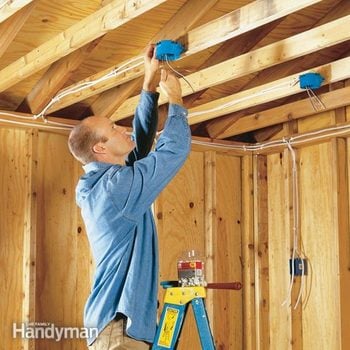
Frustrated past too few outlets in your garage? Lighting that's too dim? Or possibly yous but desire to install a garage door opener and need a nearby plug-in.
If so, this article is for y'all. Garage wiring has special rules. Then earlier installing those extra outlets, read through the details in this story to make sure that you lot're doing it safely and co-ordinate to the Electrical Code.
You lot might also like: TBD
- Time
- Complexity
- Toll
- A full day
- Intermediate
- $51–100
Basic wiring strategy for garages
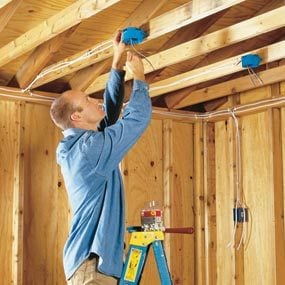
Wiring an unfinished garage.
Wire your unfinished garage to get the lights and outlets yous need.
Whether you're rewiring or adding more wiring to an older garage, or running wires in a new garage, you accept a decision to make. Do you plan to leave the walls open or close them upward with drywall? If you intend to get out the walls and ceiling open, yous have to follow the special rules that we show here. The same goes for sheds, workshops or other structures with unfinished walls outside the living space of the house.
In a house or a finished garage, electric cablevision is protected from damage by permanent wallcoverings like drywall, plaster or even wood, but that's non the case in an unfinished garage. The key to condom, lawmaking-compliant exposed wiring is to use the framing members to protect and back up the wires. That means not spanning stud or joist spaces with wires. Keep all the cables closely hugging the studs, plates and ceiling joists so they're non discipline to abuse (see "Dangerous Wiring Mistakes" at the end of this article).
In this story, we'll evidence you a mutual, toll constructive and lawmaking approved manner to run exposed electrical cable. But there's 1 downside to this method: If you ever do decide to finish the area, you'll have to completely rewire considering the surface-mounted cables will brand drywalling impossible.
In an unfinished garage, the trick is to follow the framing. Instead of connecting switch, low-cal and outlet boxes by spanning framing spaces, route cable along studs, top plates and ceiling joists (Photo 3), forth whichever framing member leads to the next box (see lead photo). That means you'll employ a lot more cable, because the paths are rarely direct. But cablevision's cheap and quick to run. Proceed all cables exposed and like shooting fish in a barrel to run across and never run cables on the tops of walls; proceed them on vertical surfaces. That way the wires won't always have anything resting on them like hooks or garden tools (Photo six).
Set the boxes and run the wires
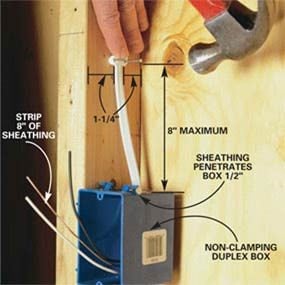
Photograph ane: Insert the wires in the box
Strip at least 8 in. of the plastic sheathing off one end of the cable and thread the wires through the electrical box cable entrance. Make sure that about 1/2 in. of the plastic sheathing at the base of the exposed wires projects inside the box Staple the cable inside 8 in. of the box. Infinite cables at least ane-one/iv in. from the front and dorsum of framing members.

Photo 2: Drill holes to run cable
Run cable alongside and centered on studs, drilling holes through blocking every bit close to the framing every bit possible to continue cable runs
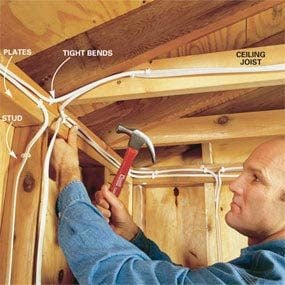
Photo 3: Bend cables around corners
Bend cable tightly around corners at transitions and staple near the bends to contain the cable.
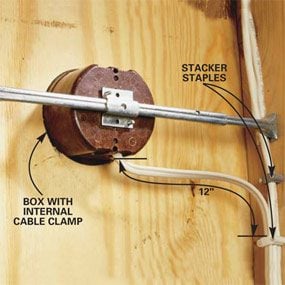
Photo 4: Staple cable most boxes
Staple within 12 in. of boxes that have built-in cable clamps. Stacker staples let for stacking cables in the eye of studs.
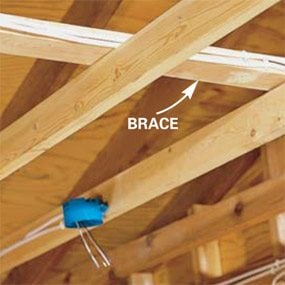
Photo five: Run cable forth the sides of braces
Run cable across ceiling joists past using the sides (not the top) of existing braces. This can shorten some cable runs.

Photo 6: Run cablevision along the gable ends.
Run cablevision forth the bottom faces of gable cease framing but never lay it atop wall plates where information technology can't be seen. If you run cable along the face of plates, don't hang tools there
Begin by planning your wiring scheme and nailing upwards all the electric boxes. To run a cable from one box to another, pull cable off the coil, strip at least 8 in. of sheathing off the wires and thread the wires and virtually i/two in. of sheathing through the wire opening in the box. Untwist the cable and staple it at least every 4 ft. to the framing, all the way to the adjacent box without cutting information technology to length. When you achieve the next box, stretch out the cable and marking the entrance point on the cable, cut the cable near a foot long, strip the capsule and feed the wires into the box. Then nail in the staples near the box.
The code requires that you concur all wires at to the lowest degree 1-1/4 in. (Photo ane) from the back and front surface of studs and joists. With 2×4 framing, that means you accept to hold two cables running side past side tight to each other. If yous're running 3 or more than cables, you lot'll need special "stacker" staples (Photo 4) so yous tin piggyback cables on top of one another. Stacker staples aren't always sold at abode centers, only you tin can discover them at electrical supply stores. Sometimes these staples are the only option because of the number of wires in a stud infinite.
Cable should be stapled at to the lowest degree every 48 in. between boxes, but as rule, the more staples the better. Avoid sagging cables and keep turns tight by using as many staples as necessary. Electric boxes may have built-in metal or plastic cable clamps. Many duplex boxes merely have knockouts. Cable should be stapled inside viii in. of boxes without clamps and within 12 in. of boxes with clamps (Photo 4).
How to run surface wiring on solid walls
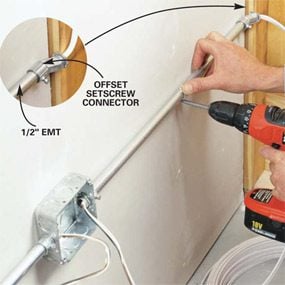
Photo 7: Protect cables on hard walls with conduit.
Protect surface cables on hard-surfaced walls by encasing them in either PVC or metal conduit. Use connectors and boxes and straps that are compatible with each type of conduit. When running cable out an open conduit stop, be sure to use a connector fitting.
Many garages contain one or more than walls made of concrete or already drywalled. Cable installed on these exposed surfaces has to be protected past conduit. We prove EMT (electric metal tubing; Photo 7), merely you can as well use rigid PVC conduit.
Utilize 1/2-in. tubing for one cablevision (14-2 or 12-2) and iii/four-in. for two cables. Whichever conduit mode you utilise, choose boxes, straps and connectors that are specifically fabricated for that type of conduit. Screw boxes to walls through the back into solid backing and use straps at least every 4 ft. to fasten the conduit to the wall. Route conduit until you attain the open up stud spaces and so continue wiring as we've described. Never exit wires through cut ends of conduit because the sharp metallic edges tin can cut into the sheathing. Ever get out cablevision through connectors.
Dangerous Wiring Mistakes
Avert running cables like nosotros show in the photos beneath. Cables that span stud spaces or ceiling joists are in constant jeopardy of nicks or cuts from sharp shovels, opening car doors or nearly anything else y'all'll find in a garage. As if that'due south non bad enough, information technology'south too tempting to use them for tucking, hanging or trapping all kinds of paraphernalia to become information technology off the floor and out of the way.
Required Tools for this Project
Have the necessary tools for this DIY project lined upwardly before you start—you'll save time and frustration.
Required Materials for this Project
Avoid last-minute shopping trips by having all your materials set up ahead of time. Here'southward a list.
Originally Published: June 20, 2017
Source: https://www.familyhandyman.com/project/how-to-wire-a-garage-unfinished/#:~:text=Many%20garages%20contain%20one%20or,Use%201%2F2%2Din.
0 Response to "what kind of conduit needs to be used inside garage"
Post a Comment